
New Mexico’s Clean Transportation Fuel Standard | Where do I fall? | Why opt in?
How to participate | Training materials
Glossary
How to participate
Parties participating in the Clean Transportation Fuel Program will:
1. Register your organization as a participant in the Applications, Reporting, and Compliance System (ARCS)
CTFP-ARCS User Registration Guidance (PDF)
2. For providers of gaseous fuel and electricity as transportation fuel, register your Fuel Supply Equipment in ARCS
For ARCS to calculate credits and deficits for providers of these fuels, owners of Fuel Supply Equipment must register their New Mexico equipment, track transactions, and report transportation fuel dispensed to vehicles as part of their quarterly reporting.
CTFP-ARCS FSE Registration Guidance (PDF)
3. Determine your carbon intensity (CI) score
To fulfill reporting obligations and to generate credits and deficits, participants must use carbon intensities (CIs) approved by the program when reporting for the previous quarter. NMED determines CIs depending on the fuel type and its pathway, or the emissions “journey” that fuel takes, including feedstock, production, transportation, and use.
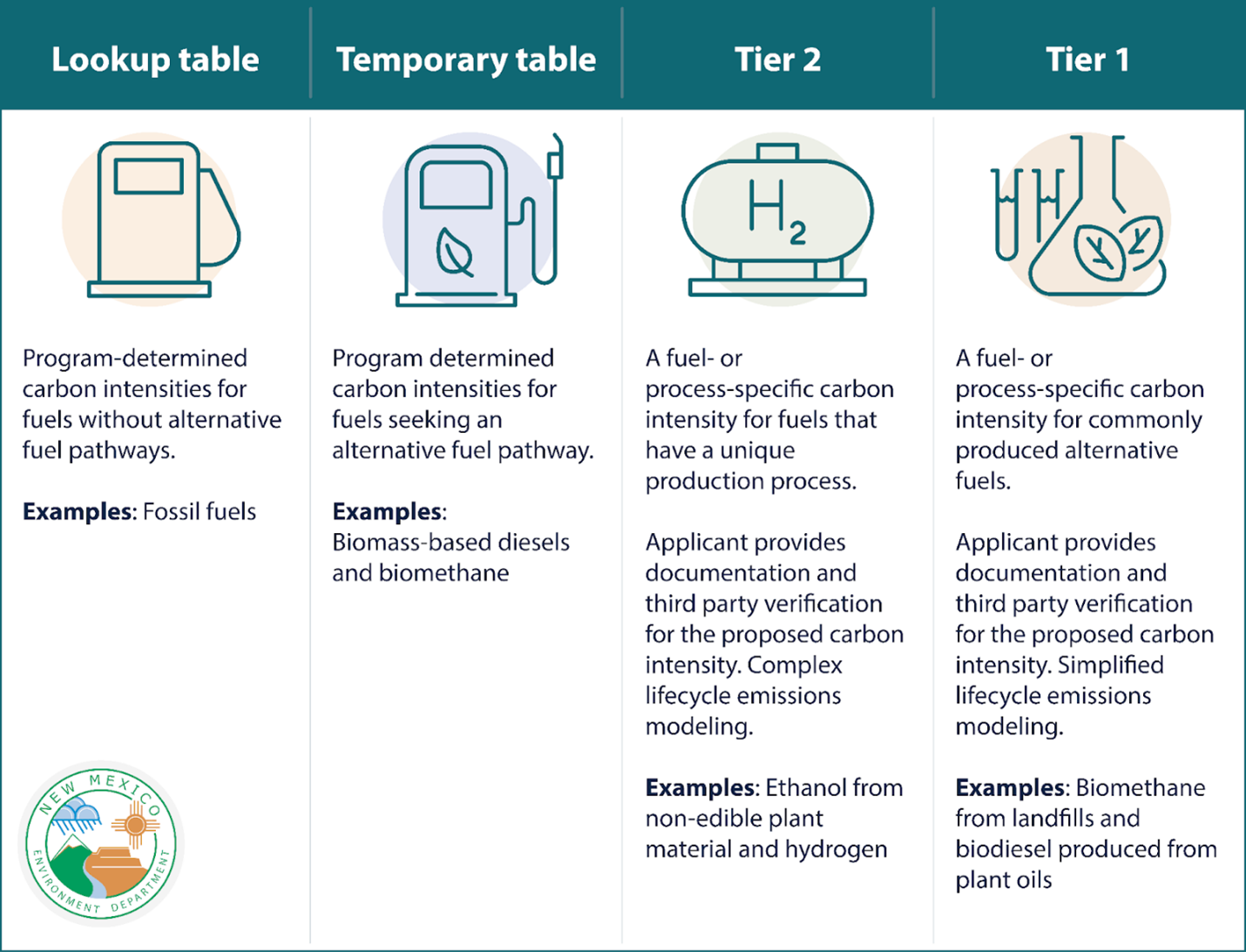
Generally, a fuel importer, producer, or dispenser can obtain a CI in four ways:
- Lookup table: CIs for unblended gasoline or diesel, fossil compressed or liquified natural gas, liquified petroleum gas (propane), and renewable electricity. See Table 4
- Temporary carbon intensities: Temporary CIs for a participant to use as part of a temporary fuel pathway while they apply for a “permanent” New Mexico Alternative Fuel Pathway. Participants may use temporary CIs from clean fuel programs in other states, temporary CIs from Table 5, or apply for a new temporary fuel pathway through the first CTFP compliance period.
- For more detailed instructions, see this Essential FAQ.
- Tier 1: CI calculators for commonly produced alternative fuel types for a participant’s use in an alternative fuel pathway application process.
Tier 1 (T1) calculators and instructions
T1 Biodiesel Calculator (XLSM) | T1 Biodiesel Instructions (PDF)
T1 Biomethane LFG Calculator (XLSM) | T1 Biomethane LFG Instructions (PDF)
T1 Biomethane Manure Calculator (XLSM) | T1 Biomethane Manure Instructions (PDF)
T1 Biomethane OW Calculator (XLSM) | T1 Biomethane OW Instructions (PDF)
T1 Biomethane WWS Calculator (XLSM) | T1 Biomethane WWS Instructions (PDF)
T1 HEFA Calculator (XLSM) | T1 HEFA Instructions (PDF)
T1 Hydrogen Calculator (XLSM) | T1 Hydrogen Instructions (PDF)
T1 Starch Fiber Ethanol Calculator (XLSM) | T1 Starch Fiber Ethanol Instructions (PDF)
- Tier 2: CI calculators for new or innovative alternative fuel types that have a unique or complex production process for a participant’s use in an alternative fuel pathway application process.
Tier 2 (T2) calculator and guidance
Tier 2/NM-GREET 1.0 Calculator (XLSM) | T2/NM-GREET 1.0 Guidance (PDF)
See graphic below for examples of 1-4.
Determining electricity CIs:
Generally, an electric vehicle (EV) electricity dispenser may obtain a CI depending on how the electricity is sourced or generated, for example:
- Grid electricity: Electricity dispensed to EVs that is from a utility grid uses the CI for that utility. NMED calculates, approves, and announces these CIs annually by May 30. NMED’s Carbon intensity values for utilities are published on our Program guidance documents, forms, & FAQs page.
- Renewable electricity: Electricity dispensed to EVs that is solely generated by solar, wind, hydropower, or geothermal power may use the CI listed in Table 4, which is zero.
- Other off-grid electricity: Electricity dispensed to EVs that is not connected to a utility grid and is not from an approved renewable generation source may pursue a CI through an alternative fuel pathway application. See dropdown menus above for Tier 1 and Tier 2 calculators and instructions or on our Program guidance documents, forms, & FAQs page.
Otherwise, CTFP allows electricity used in the production lifecycle of other fuel types to be accounted for in an application for an alternative fuel pathway. The accounting provisions permit the use of book-and-claim methods.
4. Keep records and submit required reports
Program participants are required to report information to NMED through the Applications, Reporting, and Compliance System (ARCS). Typical submissions include:
- Quarterly Fuel Reports: to report transaction types and unique information for various fuel types;
- Annual “compliance period” reports: to demonstrate the regulated party’s balance of credits and deficits; and
- Additional annual reports: to affirm claims related to unique actions such as claiming residential electric vehicle (EV) charging credits or demonstrating compliance with approved alternative fuel pathways.
For more detailed reporting information, see important dates.
- CTFP’s first quarter is April 1 to June 30, 2026.
- Report this data in ARCS from August 24 to October 15, 2026.
- Resolve submitted data discrepancies and make final corrections between October 15 and November 23, 2026.
- CTFP’s first compliance period is seven quarters, from April 1, 2026, to December 31, 2027.
- Report this data from January 1 to April 30, 2028.
- Electric utilities and electric vehicle (EV) manufacturers claiming residential EV charging credits have delayed reporting requirements, due July 1, 2028.
- To satisfy duplicative reporting requirements, electric utilities may submit the Public Regulation Commission’s required reports to NMED.
5. Pay program fees
| Fee type | Who pays | When | Basis or Amount* |
|---|---|---|---|
| One-time program registration fee | Any person who is required or wishes to opt into CTFP | Assessed as a part of the registration process; paid before the Department approves an ARCS account. | $3,000 for credit and deficit generators $500 for all other registered parties |
| Annual CTFP fee | All regulated parties | The announcement of the final CTFP budget will be on October 31, 2026, and then on July 1 each subsequent year. Fee invoices will be sent to participants within 30 days of the announcement. Payment is due within 30 calendar days of the date of the department’s invoice. For example, the initial annual fee payment will be due no later than December 30, 2026. | CTFP is a self-funded program and is not reliant on the legislature’s general fund. Annual fees are paid by all CTFP participants based on the following: 1. NMED determines the program’s total CTFP budget based on the activities involved in administering the CTFP. 2. The total budget is split so that deficit generators cover 95% of the cost and credit generators cover the remaining 5%. 3. Each participant’s annual fee is prorated within the 95% and 5% categories, based on the number of credits or deficits generated. |
| Application fees, including for: 1. Alternative Fuel Pathway Applications 2. EER Pathway Applications 3. FSE Pathway Applications 4. Project Credit Applications | Applicants | Invoiced to applicant by NMED at time of application; payment due within 30 days and no later than the time of NMED’s approval of the application. | $5,500 for a Tier 1 alternative fuel pathway application, EER pathway application, and FSE pathway application $15,000 for a Tier 2 alternative fuel pathway application. Project credit fees shall be calculated for each project and assessed on a full cost-recovery basis. |
* All fees are subject to an annual inflation adjustment, per 20.2.92.502.G. NMAC. Additionally, if fees are not paid by the due date, they are subject to late fees and penalties, per 20.2.92.502.H. NMAC.
6. Maintain compliance
- Settle deficits (generated April 1, 2026, through December 31, 2027) with credits by April 30, 2028.
- First compliance report due April 30th, 2028, then yearly after.