
The New Mexico Environment Department is conducting water quality testing of private wells in the burn scar of the 2022 Hermits Peak-Calf Canyon Wildfire.
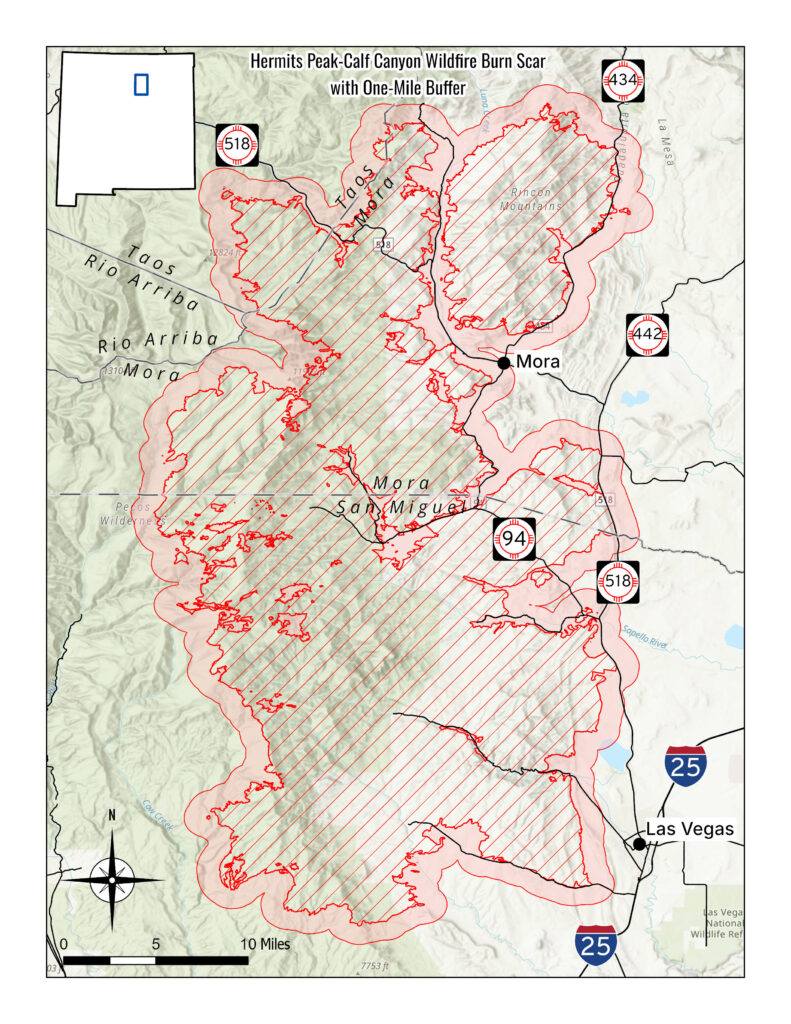
The New Mexico Environment Department (NMED) is offering free sampling of private groundwater wells for heavy metals and other contaminants recently found in the burn scar of the Hermits Peak-Calf Canyon Wildfire. Only residents of Mora, San Miguel, and Taos counties who were directly impacted by the wildfire are eligible for testing.
Groundwater wells used for drinking water can be sampled at no cost to eligible private well owners.
Sampling will be scheduled on a rolling basis based on staffing, funding and well locations.
Sampling began on Dec. 15, 2025 and will continue through October, 2026 (as funding allows). NMED will provide eligible private well owners with their results following analysis by a certified laboratory. NMED will accept new sampling requests through the month of October, 2026.
To sign up to have your private well tested, fill out our form by clicking the Request Private Well Sampling button below. NMED expects to conclude its private water well WQ sampling program by early November, with a final report of the testing program made available by the end of 2026.
Frequently Asked Questions
Multiple agencies from across the state have put together frequently asked questions to help guide private well owners within the Mora, San Miguel, and Taos County areas.
Where is NMED conducting private well sampling?
NMED is prioritizing well sampling near the Hermit’s Peak/Calf Canyon wildfire burn scar area and a one-mile buffer around it. The map on NMED’s website shows this geographic area. This area includes portions of Taos, Mora, and San Miguel counties.
Is NMED sampling private wells used for all purposes?
NMED is prioritizing sampling for domestic wells. This is to ensure the domestic use of water in households is as safe.
What is the source of the contamination affecting the wells in my area? Are the fire suppressants used during the wildfire the source?
NMED is working with other state agencies to determine the source of this potential contamination. The current focus right now is to help residents test the water quality of their wells.
Click on the icons below for factsheets on select contaminants:


Is it okay to use my well water for drinking and bathing?
The New Mexico Department of Health (NMDOH) is advising private well owners in or near the burn scar area to avoid consuming their water due to elevated levels of heavy metals recently found in the area’s groundwater.
Residents can decrease their exposure by using bottled water when possible. Boiling water will not remove metals from water and can increase the metals’ concentrations as water evaporates.
Out of an abundance of caution, NMDOH and NMED have advised using alternate sources of water for household use such as toothbrushing and dishwashing, though health effects from the currently reported levels are not expected in the short term but rather over years of consumption. Use of well water for bathing and showering is safe at the currently reported levels.
NMDOH strongly encourages private well owners in the burn scar area to have their well water tested to better understand individual risk level and ability to use well water for consumption and household purposes.
What are the recommended treatment options and where can I buy them?
Recommended water treatment options will depend on individual well water testing results. While whole-house reverse osmosis systems are typically recommended as an effective treatment system to reduce exposure to contaminants, RO systems generate a waste product that can be a challenge to manage, with potential impacts to septic systems. More information about these types of systems is available on EPA’s Point of Use Reverse Osmosis System webpage. Other options are point-of-use filters, as described in this POU Filter Flyer for Private Well Owners in the Hermits Peak-Calf Canyon geography
What are the health effects of the heavy metals NMED is sampling for?
The New Mexico Department of Health’s fact sheet on heavy metals in Mora County gives an overview of health effects.
Is NMED providing treatment equipment?
NMED is only sampling wells and not providing treatment equipment at this time. Disaster case managers from the New Mexico Department of Homeland Security and Emergency Management (DHSEM) are available to assist residents with recovery resources, including help with Claim’s Office paperwork to request compensation for treatment. Those interested can call (505) 670-4662 for assistance.
Additionally, USDA-Rural Development is offering a federal grant for HPCC residents who need to repair their water systems and/or install water filtration devices. Call USDA-RD’s main line at (505) 761-4950 for more information about this reimbursement-based grant program.
Why is NMED sampling for PFAS in this area?
NMED is sampling for PFAS in addition to heavy metals to be consistent with statewide efforts on PFAS identification.
What are the health effects of PFAS?
PFAS are a group of manufactured chemicals that have been used since 1940 in industry and consumer products, including firefighting foam. Surveys conducted by CDC show that most people in the United States have been exposed to at least some PFAS, which can accumulate in the body over time. Most known exposures are relatively low, but some can be high, particularly when people are exposed to a concentrated source over long periods of time.
PFAS exposure has been linked to various health issues, though research is still ongoing. Studies have linked PFAS to a variety of health effects including increased cholesterol levels, risk of obesity, decreased fertility or increased high blood pressure in pregnant women, developmental delays in children, increased risk of certain cancers, and reduced ability to fight infections. However, health effects will vary by individual depending on many factors including level, length, and type of exposure, as well as individual risk factors.
When should we seek medical attention?
While NMDOH does not anticipate immediate health effects from well water at the current contaminant levels, the department recommends seeking medical care when individuals are not feeling well or have health concerns.