
PFAS are used in consumer products for their oil and water repellant properties, their ability to create low friction surfaces, heat and chemical stability, and for their properties that allow for liquids to be spread evenly.
What consumer products contain PFAS?
PFAS can be found in a variety of consumer products including:
- Cookware
- Food packaging
- Dental floss
- Juvenile products
- Firefighting foam
- Carpets and rugs
- Ski wax
- Textiles and fabric treatments
- Cosmetics and personal care products
- Cleaning products
Recent studies have evaluated the prevalence and concentration of PFAS in various consumer products. Researchers found the highest concentrations of PFAS in household firefighting products, textile finishing agents, and household chemicals, and found 72 different types of PFAS used in textiles.
Avoiding PFAS in products
Until the PFAS label is available on products in New Mexico, NMED recommends the following online resources for information on PFAS-free purchasing:
New Mexico’s PFAS Protection Act


 NOTICE: On September 16, 2026, a federal district court issued an injunction halting the New Mexico Environment Department’s (NMED) enforcement of the PFAS labeling requirement outlined in 20.13.2.13 NMAC.
While NMED is currently appealing this ruling to the U.S. Court of Appeals for the Tenth Circuit, the district court’s injunction remains in effect. Consequently, during the pendency of the appeal and the ongoing litigation, NMED is prohibited from enforcing the labeling requirement.
The PFAS Protection Act, passed by the New Mexico Legislature and signed into law by Governor Michelle Lujan Grisham in April 2025, is an innovative, science-based law to help protect residents from exposure to Per- and Polyfluoroalkyl substances (PFAS), also known as “forever chemicals.” This visionary approach is necessary to slow New Mexicans’ exposure to these chemicals, as certain PFAS are known to cause serious health and environment effects.
NMED is enforcing the PFAS Protection Act through 20.13.2 NMAC, approved by the Environmental Improvement Board (EIB) in April 2026. By phasing out the sale of certain products made with PFAS and requiring a label on products made with PFAS that are still allowed, manufacturers are encouraged to develop alternative products without PFAS and retailers to promote them. The product label improves transparency and makes it easy to identify products that contain PFAS, empowering purchasers to select available PFAS-free alternatives with confidence.
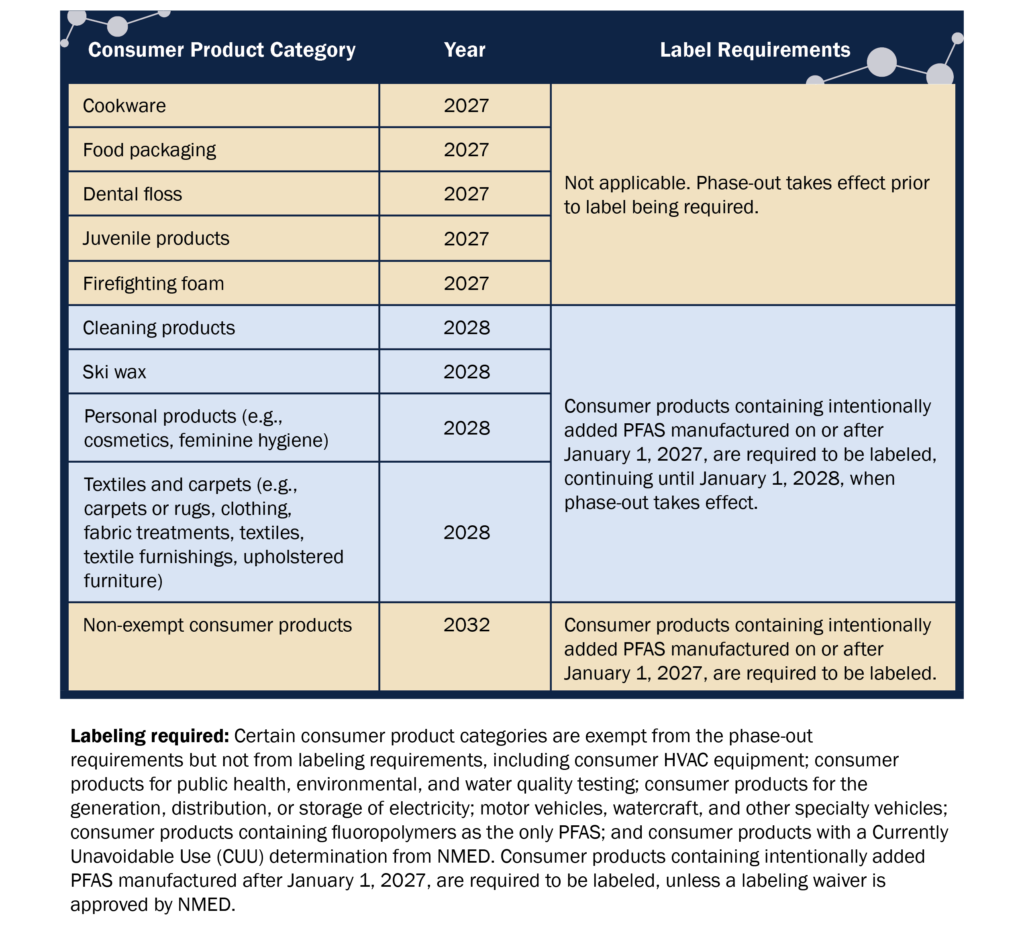
Beginning in 2027, certain cookware, food packaging, dental floss, and children’s products sold in New Mexico cannot be made with intentionally added PFAS. On January 1, 2028, the prohibition expands to include carpets, cleaning items, fabrics, textiles, ski wax, upholstered furniture, and some personal care products. New Mexico will also require manufacturers to tell consumers if they have added PFAS in products by placing a PFAS symbol on the product, its packaging, websites, or product manuals and other literature. By January 1, 2032, all non-exempt products containing intentionally added PFAS will be prohibited unless deemed a “currently unavoidable use.”
Product Phase-Out/Labeling Timeline
Manufacturers of products that contain intentionally added PFAS must also begin reporting detailed information about PFAS content in their products by 2027.
Rulemaking Process and Previous Engagement Opportunities
Under the PFAS Protection Act, the New Mexico Environment Department was required to pass rules through the Environmental Improvement Board, or EIB, to govern the processes, requirements, and enforcement of the new law.
NMED filed its proposed rules to govern the processes, requirements, and enforcement of the new law to the EIB (PDF) on October 8, 2025. In addition, NMED opened a public comment portal for those wishing to provide feedback on the proposed rules. Additional materials related to the rulemaking and EIB process are available on EIB’s “Docked Matters” page. The rulemaking hearing was held in February 2026 where NMED presented technical testimony of national and Department PFAS experts. Following the hearing, the EIB adopted the Final Rule, which was published in the New Mexico Register in May 2026 (20.13.2 NMAC). Following the rulemaking hearing and the publication of the Final Rule, the Department has developed public and manufacturer education campaigns.
As part of the rulemaking process, NMED has and will continue holding a series of public engagements to allow New Mexicans to learn and ask questions about the PFAS Protection Act:
- Stakeholder Webinar —Thursday, September 25, 2025
- Presentation Slides (PDF)
- Full Webinar Recording (YouTube)
- Public Informational Webinar — Wednesday, October 22, 2025 at 1 p.m. MT
- Presentation Slides (PDF)
- Full Webinar Recording (YouTube)
- NMED Presentation at NMSU PFAS Event — Friday, May 1, 2026
- Presentation Slides (PPTX)
- House Joint Memorial 3 Webinar – Tuesday, August 18, 2026
- House Joint Memorial 3 Stakeholder Meeting – Thursday, October 8, 2026